
In the STEM framework, E stands for Engineering.
Engineering is about designing solutions, building structures, solving practical problems, and improving ideas through testing and refinement. For children, engineering begins with curiosity: How can I build this? Why does it fall? How can I make it stronger?
BAKOBA transforms engineering concepts into hands-on exploration. Through construction play, children experiment with structure, stability, reinforcement, and design optimization — all essential elements of early engineering education.
Engineering is learning by building.
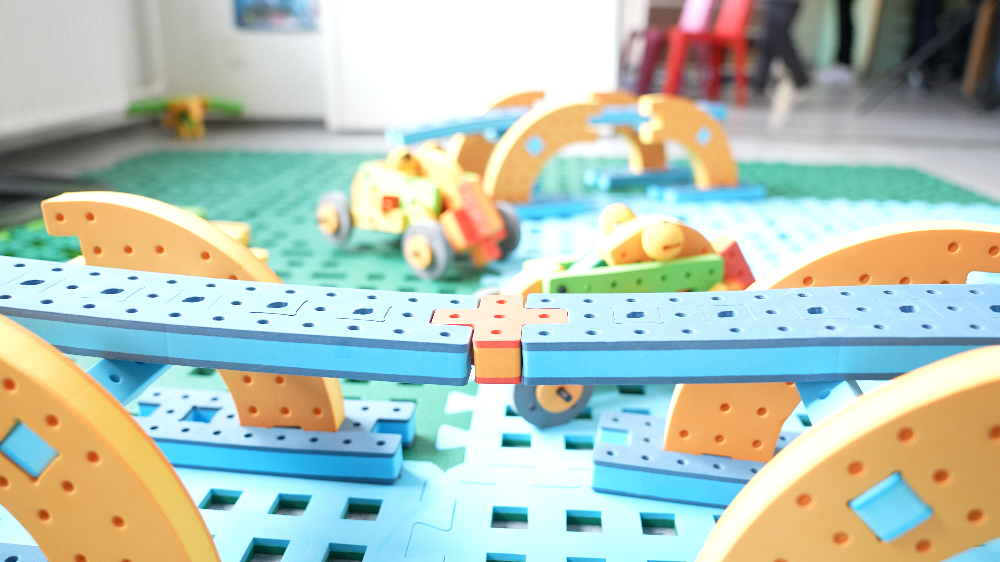
1. Structural Design and Stability
Foundation building: Wide bases increase balance and strength.
Load distribution: Children observe how weight affects stability.
Reinforcement strategies: Adding support elements improves durability.
Through building and rebuilding, children develop an intuitive understanding of structural engineering principles.
2. The Engineering Design Process
Planning: Children imagine and sketch (mentally or physically) their designs.
Building: They construct their idea using available elements.
Testing: Structures are evaluated for strength and function.
Improving: Adjustments are made based on results.
This mirrors the real-world engineering cycle: design, prototype, test, refine.
BAKOBA naturally supports iterative improvement — a cornerstone of engineering thinking.
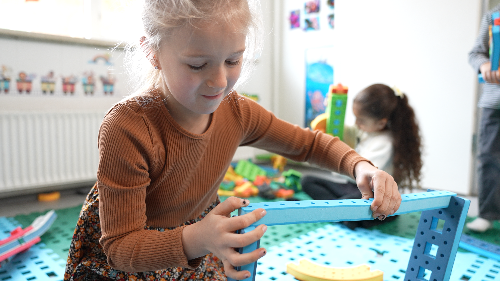
3. Problem-Solving and Critical Thinking
Identifying weaknesses: Why did the structure collapse?
Analyzing variables: Is the base too narrow? Is weight uneven?
Developing solutions: Modify the design and test again.
Engineering requires analytical reasoning and resilience. BAKOBA encourages persistence by making redesign safe and frustration-free.
4. Scale and Ambition in Design
Lightweight materials: Allow children to build large-scale structures.
Flexible components: Introduce dynamic design possibilities.
Safe experimentation: Soft EVA foam enables bold construction attempts.
Because BAKOBA is soft and durable, children feel confident experimenting with ambitious builds — strengthening creative engineering capacity.
5. Collaborative Engineering
Team construction: Larger projects require cooperation.
Role distribution: Builder, designer, tester — natural collaboration emerges.
Shared problem-solving: Groups evaluate and refine designs together.
Engineering in real life is collaborative. BAKOBA encourages communication and teamwork through shared building challenges.
Assessment of the Unique Qualities of BAKOBA in Relation to Engineering Education
BAKOBA offers distinctive features that enhance early engineering learning:
Soft and flexible EVA foam: Enables safe structural experimentation.
Lightweight elements: Encourage large-scale engineering projects.
Noise-free material: Supports focused testing and evaluation.
Durable and washable design: Ideal for repeated prototyping in schools.
Floatation capability: Extends engineering exploration into water-based challenges.
Compatibility with other systems (e.g., LEGO®): Expands complexity and structural precision.
Open-ended construction: Allows multiple design solutions rather than fixed outcomes.
These qualities create an accessible introduction to engineering thinking and design methodology.
Conclusion
The unique properties of BAKOBA (flexibility, safety, durability, scalability, and system compatibility) make it a powerful tool for early engineering education by:
Strengthening understanding of structure and stability.
Encouraging iterative design and prototyping.
Developing analytical problem-solving skills.
Supporting collaborative engineering challenges.
Making hands-on engineering safe, engaging, and creative.
BAKOBA helps children discover that engineering is not only about complex machines — it begins with curiosity, construction, and the courage to improve an idea.
Literature Supporting Engineering Learning Through Play
National Research Council. (2009). Engineering in K–12 Education: Understanding the Status and Improving the Prospects. National Academies Press.
Honey, M., Pearson, G., & Schweingruber, H. (2014). STEM Integration in K-12 Education. National Academies Press.
Bers, M. U. (2018). Coding as a Playground. Routledge.
Hirsh-Pasek, K. et al. (2009). A Mandate for Playful Learning in Preschool. Oxford University Press.
Cunningham, C. M. & Kelly, G. J. (2017). Engineering Practices in Elementary Education.
