
In the STEM framework, S stands for Science.
Science is about understanding how the world works through observation, experimentation, and critical thinking. For children, science begins with curiosity — asking questions, testing ideas, and discovering cause and effect.
BAKOBA transforms scientific principles into hands-on learning experiences. Through construction play, children explore physics, forces, balance, motion, and even buoyancy in a safe and engaging way.
Science becomes something they do — not just something they learn about.
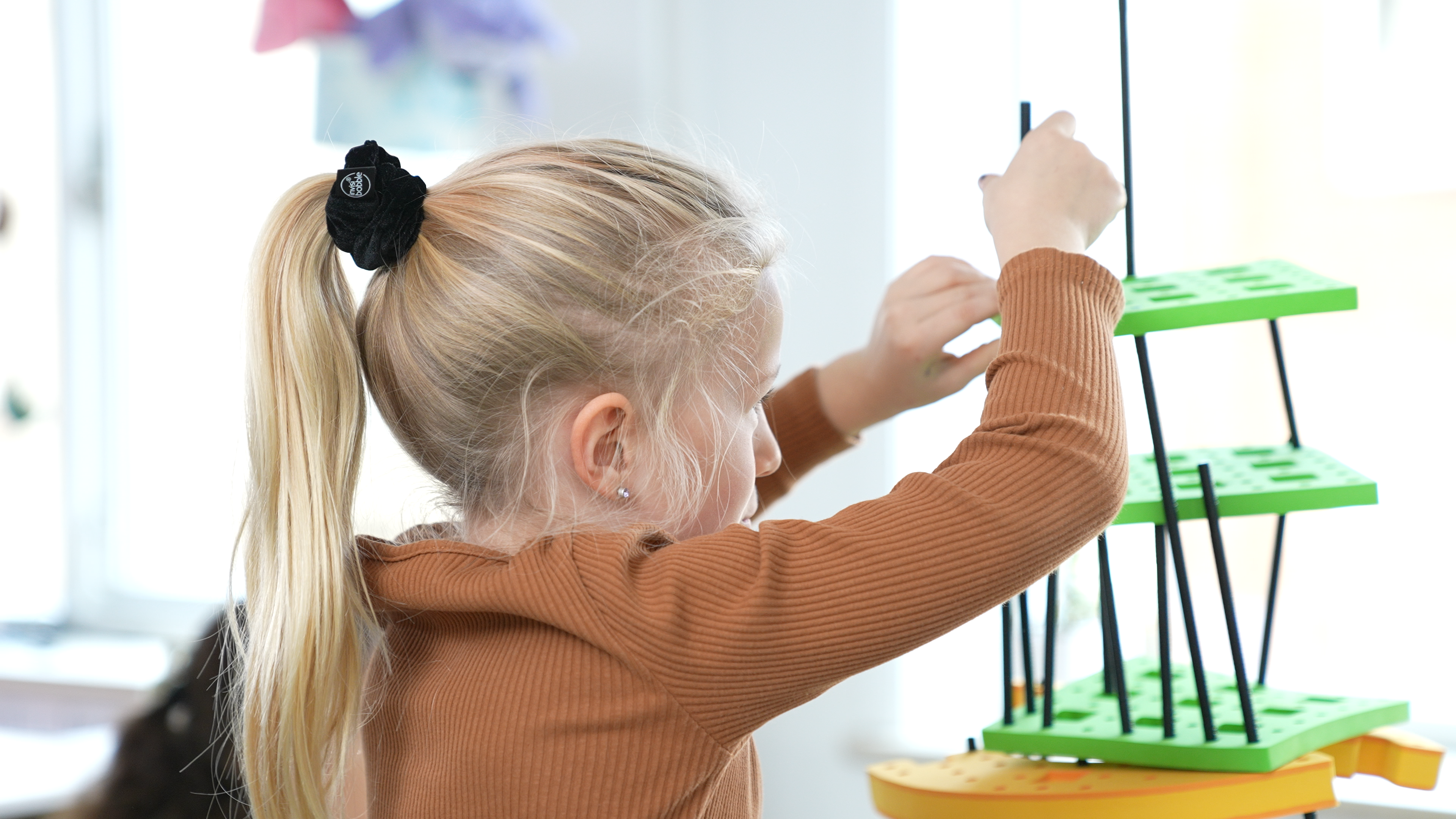
1. Learning Through Experimentation
Trial and error: Children quickly see what works — and what does not.
Observation skills: They analyze why a structure collapses or remains stable.
Hypothesis building: “What happens if I change this piece?” encourages predictive thinking.
Scientific learning begins with testing ideas. BAKOBA naturally supports this process by allowing children to modify and improve their constructions repeatedly.
2. Exploring Core Physics Concepts
Balance and gravity: Tall or asymmetrical builds demonstrate stability principles.
Force and motion: Flexible elements allow pushing, bending, and dynamic movement.
Structural engineering basics: Wide bases and reinforced designs improve strength.
Because BAKOBA blocks are soft and lightweight, children feel safe building large or experimental structures — promoting deeper exploration of scientific concepts.
3. Understanding Cause and Effect
Immediate feedback: If weight is uneven, the structure reacts instantly.
Material response: Bending and compression demonstrate physical properties.
Iterative improvement: Children adjust designs based on observed outcomes.
This hands-on cause-and-effect learning strengthens analytical thinking and scientific reasoning.
4. Water-Based Science Exploration
Buoyancy experiments: BAKOBA floats, enabling exploration of floating and sinking.
Water resistance: Children can observe movement in water versus air.
Safe STEM play: Durable and washable materials support repeated experimentation.
Water play extends science learning beyond traditional building activities, introducing early physics concepts in a playful way.
5. Inquiry-Based STEM Learning
Open-ended challenges: There is no single correct outcome.
Problem-solving tasks: Children design solutions to structural or balance challenges.
Independent exploration: Encourages curiosity-driven learning.
Modern STEM education emphasizes inquiry and experimentation. BAKOBA aligns with these principles by turning play into structured scientific discovery.
Assessment of the Unique Qualities of BAKOBA in Relation to Science Education
BAKOBA offers several distinctive features that enhance early science learning:
Soft EVA foam: Enables safe exploration of force, compression, and movement.
Noise-free material: Supports focused experimentation without sensory overload.
Lightweight design: Encourages ambitious structural experiments.
Floatation capability: Introduces buoyancy and water-based STEM exploration.
Easy cleaning and durability: Ideal for classrooms and institutional settings.
Compatibility with other systems (e.g., LEGO®): Expands engineering and scientific complexity.
Flexible elements: Add dynamic variables not found in rigid construction toys.
These features create an accessible and engaging platform for early STEM education.
Conclusion
The unique properties of BAKOBA (flexibility, safety, floatation, durability, and compatibility) make it a powerful tool for early science learning by:
Encouraging experimentation and hypothesis testing.
Supporting understanding of balance, gravity, force, and motion.
Strengthening cause-and-effect reasoning.
Promoting inquiry-based and hands-on STEM education.
Making scientific exploration safe, playful, and engaging.
BAKOBA helps children experience science in action — building the foundation for future STEM confidence and curiosity.
Literature Supporting Play-Based Science Learning
National Research Council. (2007). Taking Science to School: Learning and Teaching Science in Grades K-8. National Academies Press.
Piaget, J. (1970). Science of Education and the Psychology of the Child. Viking Press.
Hirsh-Pasek, K. et al. (2009). A Mandate for Playful Learning in Preschool. Oxford University Press.
Worth, K. (2010). Science in Early Childhood Classrooms.
